
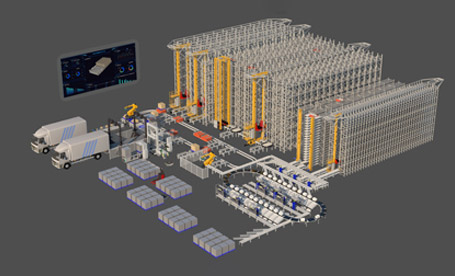
Solutions and Consulting: With decades of experience, DELIECN provides intelligent warehousing & logistics solutions and consulting services for clients across a wide range of industries.
Learn More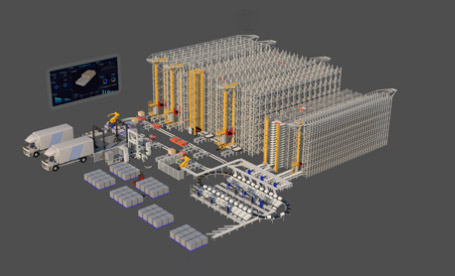
Solutions and Consulting: With decades of experience, DELIECN provides intelligent warehousing & logistics solutions and consulting services for clients across a wide range of industries.
Learn More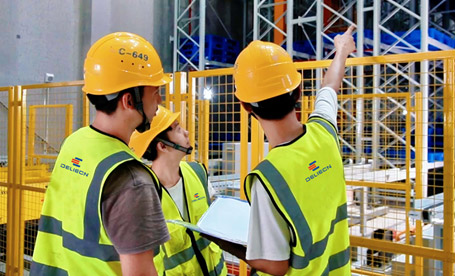
Solutions and Consulting: With decades of experience, DELIECN provides intelligent warehousing & logistics solutions and consulting services for clients across a wide range of industries.
Learn More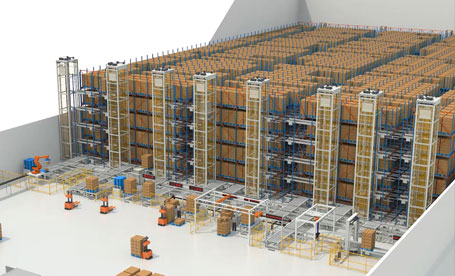
Solutions and consulting: DELIECN has decades of experience providing logistics & warehouse automation for the key industries.
Learn MoreTitanium sponge does not look like a difficult warehouse item until it has to be moved repeatedly between receiving, storage and production.
In this project, the material is packed in steel drums. Each drum weighs about 270 kg, while a loaded pallet reaches 1,125 kg. That makes daily handling very different from moving cartons or lightweight components.
The manufacturer produces advanced titanium and titanium-alloy materials for applications including aerospace, shipbuilding, nuclear power and precision manufacturing.
As its new production site was planned, continuing to store raw materials on the floor would have tied up valuable factory space while leaving much of the heavy handling dependent on people and forklifts.
The warehouse therefore needed to do more than put pallets away. It had to connect storage with the material-feeding process.
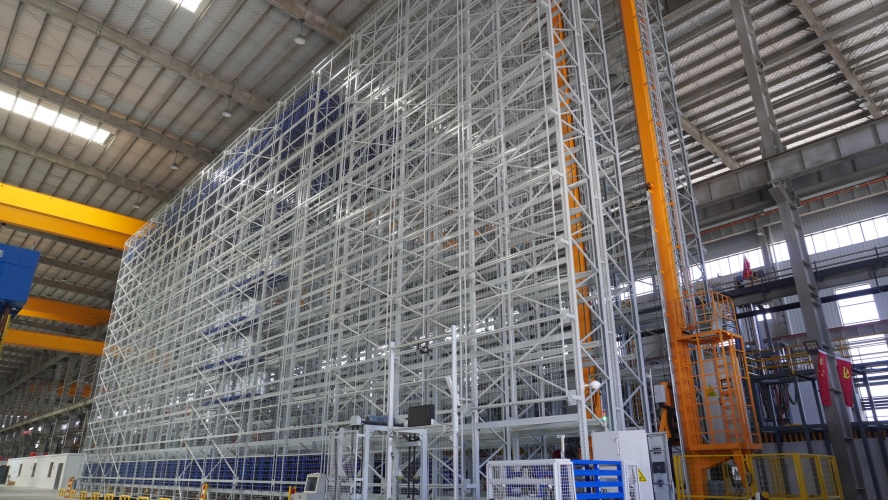
The AS/RS is approximately 17.7 meters high, with 10 storage levels and 2,072 pallet locations across two storage areas.
Each storage location is designed for a 1,125 kg load unit, and double-deep racking is used to make better use of the available building volume.
The project can accommodate more than 2,000 tonnes of titanium sponge raw material.
Two Pallet Stacker Cranes handle storage and retrieval inside the rack, replacing a large part of the forklift movement that would otherwise take place inside the storage area.
Project results show that space utilization reached about five times the previous floor-storage level.
In this project, retrieving the pallet is not the end of the job.
Production ultimately needs the individual drums.
The downstream process therefore combines conveyors, 4 AGVs and gantry handling equipment.
The AGVs transfer loaded pallets between defined warehouse and production-side interfaces. At the feeding area, a dedicated gripper handles the 600 mm diameter, 1,000 mm high, 270 kg drums individually.
The gantry handling system is designed for approximately 40 cycles per hour.
This connects pallet storage with the next production step instead of leaving operators to complete the heavy transfer manually.
The project also uses a deliberately separated operating rhythm.
Concentrated inbound is designed around 30 pallets per hour. During this period, outbound does not run at the same time. Raw-material outbound and empty-pallet return are also arranged in separate periods so the flows do not compete for the same equipment.
That may sound less sophisticated than trying to run every process simultaneously, but it matches the actual production rhythm.
Automation works better when equipment is scheduled around real demand rather than theoretical maximum utilization.
Heavy material still has to be identified correctly.
Incoming loads use QR codes, fixed readers and handheld terminals so that material information can be connected with warehouse inventory and storage locations.
WMS manages inventory and warehouse tasks. WCS coordinates Pallet Stacker Cranes, conveyors and other automated equipment, while API and ECS connect the information and control layers.
This makes it possible to track a raw-material unit through storage and subsequent handling rather than treating the warehouse as a separate process.
The system combines:
Project results report space utilization at about five times the previous level, while inbound handling efficiency improved by approximately 50%.
The practical improvement came from connecting storage, pallet transfer and drum handling.
For metals and advanced-material manufacturers, reducing manual handling often matters just as much as adding more pallet locations.
Cleverly utilizing the vertical dimension of the warehouse to achieve the ultimate expansion of storage capacity, tailored for environments with limited space, allowing every inch of space to maximize its benefits.
Cleverly utilizing the vertical dimension of the warehouse to achieve the ultimate expansion of storage capacity, tailored for environments with limited space, allowing every inch of space to maximize its benefits.
Cleverly utilizing the vertical dimension of the warehouse to achieve the ultimate expansion of storage capacity, tailored for environments with limited space, allowing every inch of space to maximize its benefits.