
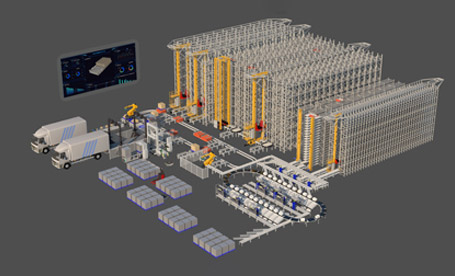
Solutions and Consulting: With decades of experience, DELIECN provides intelligent warehousing & logistics solutions and consulting services for clients across a wide range of industries.
Learn More
Solutions and Consulting: With decades of experience, DELIECN provides intelligent warehousing & logistics solutions and consulting services for clients across a wide range of industries.
Learn More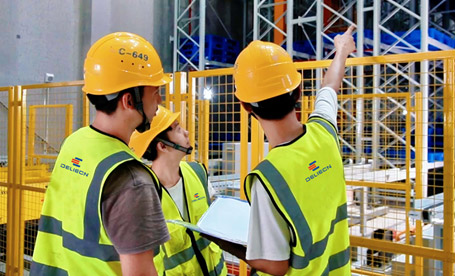
Solutions and Consulting: With decades of experience, DELIECN provides intelligent warehousing & logistics solutions and consulting services for clients across a wide range of industries.
Learn More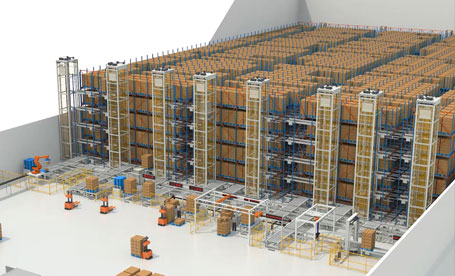
Solutions and consulting: DELIECN has decades of experience providing logistics & warehouse automation for the key industries.
Learn More
With the rapid development of modern warehousing and logistics, racks have become one of the core infrastructure components in storage systems. Their safety and stability directly affect warehouse operation efficiency, goods protection, and personnel safety.
If rack inclination, deformation, or structural deviation is not detected in time, it may lead to risks such as goods falling, rack instability, equipment interference, or even safety accidents.
This article introduces an IoT-based automatic detection and alarm notification system for rack verticality and levelness. The system uses multi-axis MEMS accelerometers and gyroscopes, combined with Kalman filtering, to achieve high-precision attitude estimation. It continuously monitors rack verticality, horizontal inclination, and structural posture changes.
When the detected value exceeds the preset safety threshold, the system automatically triggers a multi-level alarm mechanism. Alarm information can be sent to warehouse owners or managers through SMTP email and third-party SMS interfaces.
Test results show that the system can achieve verticality detection accuracy of ±0.05°, levelness detection accuracy of ±0.08°, alarm trigger delay of less than 3 seconds, and email/SMS delivery rates above 99.5%.
With the expansion of e-commerce, manufacturing, cold chain, and automated warehousing, high-density rack systems and AS/RS warehouses are widely used. In these systems, racks are not only storage structures, but also key components that support automated operation.
Rack safety directly affects:
• goods storage stability
• automated equipment operation
• warehouse personnel safety
• long-term system reliability
• maintenance and inspection efficiency
Traditional rack safety inspection mainly depends on manual periodic checks. This method has several limitations. Inspection intervals are long, manual errors are difficult to avoid, hidden risks may be missed, and abnormal information cannot always be sent to managers in real time.
Therefore, an automatic system that can continuously detect rack verticality and levelness, identify abnormal tilt, and send alarm notifications through email and SMS has practical value for modern warehouse safety management.
The rack monitoring system adopts a three-layer architecture:
The sensing layer consists of multiple sensor nodes. Each node includes a MEMS inertial measurement unit, a low-power microcontroller, and a communication module.
Sensor nodes are installed at key positions of rack uprights, beams, and structural nodes. They collect raw acceleration and angular velocity data, and perform local preprocessing.
The network layer includes the on-site gateway and cloud server connection.
The gateway collects sensor data, performs protocol conversion, and uploads data to the cloud through Ethernet, 4G, or other communication methods. It can also support local alarm logic, so basic alarm functions can still be executed when the network connection is interrupted.
The application layer is deployed on the cloud server or monitoring platform. It is responsible for:
• data storage
• threshold management
• alarm decision-making
• notification sending
• user permission management
• real-time monitoring interface
• historical data query
The system can send alarm emails through SMTP and send SMS alerts through third-party SMS service APIs.
Rack verticality refers to the inclination angle of the rack upright relative to the vertical direction. Rack levelness refers to the inclination angle of beams or structural components relative to the horizontal direction.
The system uses a three-axis accelerometer to calculate static or quasi-static inclination based on gravity acceleration projection.
However, accelerometer-only measurement is sensitive to vibration. In warehouse environments, equipment operation, loading and unloading, conveyors, forklifts, or shuttle movement may create vibration and noise.
A gyroscope provides fast dynamic response by measuring angular velocity, but it may suffer from long-term drift.
To improve accuracy and stability, the system combines accelerometer and gyroscope data through Kalman filtering. This method balances static accuracy and dynamic response, and helps reduce false alarms caused by short-term vibration.
The system can also use multi-point fusion. Multiple sensor nodes are installed at different rack positions, and the overall rack posture is evaluated through weighted data fusion.
A practical rack monitoring system should not only detect tilt values, but also classify risk levels.
The alarm strategy can be divided into several levels:
The rack verticality and levelness remain within the safe range. No alarm is triggered.
The detected value approaches or slightly exceeds the warning threshold. The system can send app push notifications or emails and suggest closer inspection.
The rack inclination exceeds the alarm threshold for a defined duration. The system can send both email and SMS alerts to warehouse managers or safety personnel.
The detected value exceeds the serious alarm threshold. The system can trigger SMS, email, and other urgent notification methods. Managers should stop operation in the affected area and arrange immediate inspection.
To reduce false alarms caused by temporary vibration, the system uses a duration confirmation mechanism. For example, warning, alarm, and critical alarm levels can be triggered only after the abnormal value remains above the threshold for a specific time.
The system collects sensor data at a defined frequency and uploads processed tilt values to the gateway. The gateway checks data integrity and sends valid data to the cloud platform.
Alarm information may include:
• warehouse name
• rack number
• rack location
• sensor node ID
• verticality value
• levelness value
• alarm level
• timestamp
• recommended handling action
The email alarm module can send detailed alarm messages to preset recipients. The email content may include rack position, alarm level, current tilt angle, threshold value, recent trend, and suggested action.
To improve reliability, the system can include retry mechanisms and duplicate alarm suppression. For example, the same rack and alarm level do not need to send repeated emails within a short period.
SMS alarms are suitable for urgent notifications. For critical rack safety risks, SMS can help ensure that responsible personnel receive alerts quickly.
For serious alarms, the system can also support escalation logic. If no one confirms the alarm within a defined time, the system can upgrade the alarm level or notify additional personnel.
The system software includes embedded firmware, cloud services, and a user management interface.
The sensor node firmware performs:
• data acquisition
• Kalman filtering
• local alarm logic
• communication with gateway
• battery monitoring
• device self-check
The cloud platform includes:
• data ingestion service
• alarm engine
• notification service
• API service
• database storage
• user and device management
Time-series data can be used to store sensor readings and alarm events. Historical data can be retained for later analysis, maintenance review, and safety inspection records.
The user interface can provide:
• real-time rack status dashboard
• rack layout visualization
• active alarm list
• historical alarm query
• trend charts
• threshold configuration
• email and phone number settings
• device online status and battery status
This makes the system easier to deploy, manage, and maintain in large warehouses.
According to the test results in the original research, the system achieved:
• verticality detection accuracy: ±0.05°
• levelness detection accuracy: ±0.08°
• alarm trigger delay: less than 3 seconds
• email and SMS delivery rate: above 99.5%
These results show that the system can provide accurate and timely rack posture monitoring for warehouse safety management.
Automatic rack verticality and levelness monitoring can help warehouses move from periodic manual inspection to continuous safety monitoring.
It is especially valuable for:
• automated storage and retrieval systems
• high-bay warehouses
• shuttle rack systems
• pallet rack warehouses
• cold storage warehouses
• pharmaceutical and food warehouses
• large distribution centers
• warehouses with high-value or heavy goods
The system helps improve rack safety visibility, reduce missed inspection risks, and provide traceable data for maintenance and safety management.
Rack safety is a key part of warehouse safety and long-term system reliability. Manual inspection is still necessary, but it is difficult to detect all structural changes in real time.
The automatic rack verticality and levelness detection system introduced in this article uses MEMS sensors, Kalman filtering, IoT communication, and multi-level alarm notification to monitor rack posture continuously.
With real-time detection, email and SMS alarm notification, historical data records, and visual monitoring, the system provides a practical method for improving warehouse rack safety management in automated and high-density storage environments.
What is rack verticality detection?
Rack verticality detection measures whether rack uprights are tilting away from the vertical direction. It helps identify possible deformation, installation deviation, or structural safety risk.
What is rack levelness monitoring?
Rack levelness monitoring checks whether rack beams or structural components remain level. It helps evaluate rack stability and storage safety.
Why use MEMS sensors for rack monitoring?
MEMS accelerometers and gyroscopes are compact, low-power, and suitable for continuous posture detection. When combined with filtering algorithms, they can provide stable tilt measurement.
How does the alarm system work?
When the detected tilt value exceeds the preset threshold for a defined duration, the system generates an alarm and sends notifications through email, SMS, or other configured methods.
Is this useful for AS/RS warehouses?
Yes. In AS/RS warehouses, rack stability affects stacker cranes, shuttle robots, pallet positioning, and overall system reliability. Continuous rack monitoring can help detect structural risks earlier.
Rack structure safety affects warehouse reliability, equipment operation, and long-term storage safety.
If you are planning or operating an AS/RS warehouse, high-bay rack system, or high-density storage facility, DELIECN can help you explore intelligent monitoring and warehouse safety solutions.