
Solutions and Consulting: With decades of experience, DELIECN provides intelligent warehousing & logistics solutions and consulting services for clients across a wide range of industries.
Learn More
Solutions and Consulting: With decades of experience, DELIECN provides intelligent warehousing & logistics solutions and consulting services for clients across a wide range of industries.
Learn More
Solutions and Consulting: With decades of experience, DELIECN provides intelligent warehousing & logistics solutions and consulting services for clients across a wide range of industries.
Learn More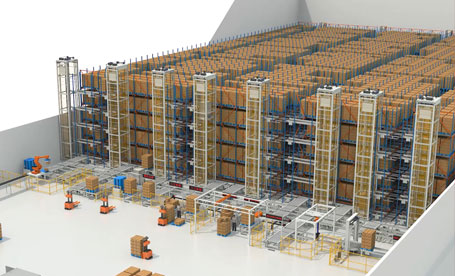
Solutions and consulting: DELIECN has decades of experience providing logistics & warehouse automation for the key industries.
Learn More
In a chemical plant handling substantial daily volumes of magnesium sulfate products, the warehouse has to do more than accommodate finished goods. Products must move from packaging and palletizing into storage, then return to the dispatch area in the right sequence and format.
The project serves a manufacturer of magnesium sulfate monohydrate and magnesium sulfate heptahydrate. The published project materials report a daily material volume of around 900 tonnes. This figure describes the scale of the operation, rather than the hourly throughput of the automated storage system.
The challenge becomes more demanding when the plant handles both 50 kg woven bags and 1-ton bulk bags. These products require different loading arrangements, even though they share the same storage operation.
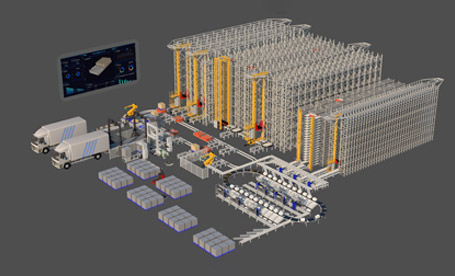
DELIECN designed an integrated warehouse system to connect these processes. The solution combines a Pallet Four-Way Shuttle AS/RS, vertical transfer equipment, conveyors, inspection and identification equipment, and loading facilities.
The objective was to make better use of the available warehouse space while keeping the movement of heavy finished goods coordinated from production through to dispatch.
The automated warehouse covers approximately 3,177.34 m². Its racking reaches 21.665 m in height, with approximately 6,309 planned positions, including storage positions and system-required technical spaces.
Pallet loads can weigh up to 1,050 kg in this project, making load handling and the coordination of horizontal and vertical movement important parts of the design.
Thirteen Pallet Four-Way Shuttle Robots handle pallet movement within the rack structure. Four Fork-Type Pallet Lifters provide vertical transfer between storage levels, connecting the shuttle system with the warehouse’s handling interfaces.
The four-way shuttle arrangement allows robots to travel along both main and sub-aisles. Rather than relying on a single fixed travel direction, the system can coordinate pallet movements across the rack according to storage and retrieval tasks.
The published project data specify a combined inbound and outbound handling capacity of approximately 132 pallets per hour. This is the system-level handling figure, not the rated speed of an individual robot or a claim that each direction independently achieves that rate.
For a high-output chemical operation, this distinction matters. Storage density creates value only when the complete handling process can move finished products into and out of the rack at the required rate.
The warehouse handles two distinct finished-product formats: 50 kg woven bags and 1-ton bulk bags. Their outbound processes were designed accordingly.
For the 50 kg products, retrieved pallets move toward the truck-loading area through an extendable belt conveyor. This supports the designated loading process, with a reported handling rate of approximately 30 pallets per hour for this route.
The 1-ton bulk bags use a gantry-based loading system. Operators connect the lifting loops to the loading equipment, after which the gantry performs the subsequent positioning and loading operation. The published project data specify a design capacity of approximately 60 pallet loads per hour for this loading system.
These figures refer to different parts of the material-handling process and should not be added together to calculate the warehouse’s overall throughput.
The two loading arrangements serve different packaging requirements without forcing both products through the same final handling process. This is an important consideration for chemical manufacturers whose finished goods differ in weight, packaging and loading method.
A high-density warehouse must keep physical loads connected to the right inventory records. Otherwise, increasing the number of storage positions can make it harder to locate and dispatch the correct goods.
In this project, barcode identification and load inspection form part of the inbound process. Before a pallet proceeds into automated storage, the system checks its identification and load condition. Loads requiring correction can be diverted to an exception-handling point rather than entering the rack immediately.
WMS manages inventory information, storage locations and warehouse tasks. WCS coordinates the execution of those tasks across the Pallet Four-Way Shuttle Robots, Fork-Type Pallet Lifters, conveyors and associated handling equipment.
This division of responsibilities links inventory information with physical equipment movements. It also gives warehouse personnel a clearer view of where a load is located and which handling stage it has reached.
For a chemical manufacturer with substantial daily material movement, this connection between identification, storage and dispatch is as important as the rack capacity itself.
The project brings high-density storage and finished-goods handling into one coordinated operation. Its published figures include approximately 3,177.34 m² of warehouse area, a 21.665 m racking height, approximately 6,309 planned positions, 13 Pallet Four-Way Shuttle Robots and four Fork-Type Pallet Lifters.
The system accommodates pallet loads up to 1,050 kg and is designed for approximately 132 pallets per hour of combined inbound and outbound handling. Separate loading arrangements support 50 kg woven-bag products and 1-ton bulk bags, while WMS/WCS connects inventory management with equipment execution.
The reported daily material volume of around 900 tonnes provides context for the scale of the chemical operation. It should not be interpreted as the automated warehouse’s daily throughput or as a result derived from the 132-pallet-per-hour figure.
The main engineering consideration is how these different processes work together. Heavy loads require suitable storage and transfer equipment; different packaging formats require appropriate outbound interfaces; and the warehouse control system must coordinate the movements between them.
For chemical manufacturers planning a high-density finished-goods warehouse, this project illustrates why storage, material handling and truck loading should be evaluated as one connected process rather than as separate equipment purchases.