
Solutions and Consulting: With decades of experience, DELIECN provides intelligent warehousing & logistics solutions and consulting services for clients across a wide range of industries.
Learn More
Solutions and Consulting: With decades of experience, DELIECN provides intelligent warehousing & logistics solutions and consulting services for clients across a wide range of industries.
Learn More
Solutions and Consulting: With decades of experience, DELIECN provides intelligent warehousing & logistics solutions and consulting services for clients across a wide range of industries.
Learn More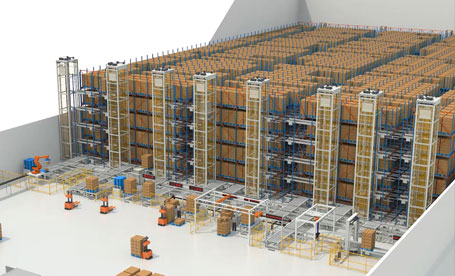
Solutions and consulting: DELIECN has decades of experience providing logistics & warehouse automation for the key industries.
Learn More
For an established paper packaging plant, warehouse automation is rarely a greenfield exercise.
Production lines are already running. Buildings already have fixed heights, columns, fire compartments and traffic routes. Finished cartons, semi-finished products, oversized loads and empty pallets still need to move through the factory every day.
The question is therefore not simply:
How can we automate the warehouse?
It is:
How can we create more storage capacity and faster material flow without disrupting the way an existing factory operates?
That was the challenge facing the customer’s factory during its warehouse logistics upgrade.
As order frequency increased, the operation had to support more production-line output, more pallet formats and increasingly concentrated shipping activity. Manual handling and floor stacking were becoming harder to scale, while frequent forklift movement continued to occupy valuable production and logistics space.
The project needed to solve several problems at the same time:
storage, production transfer, picking, outbound staging and empty-pallet return.
Paper packaging products may not look particularly complicated when viewed as individual loads.
The complexity appears when they begin moving through a working factory.
Different production areas release finished and semi-finished goods at different times. Large and small pallets coexist. Oversized products cannot always follow the same storage route. Some materials need temporary buffering before the next process, while completed orders need to reach the correct outbound area quickly.
At the customer’s factory, material flow connects production-line discharge points, post-processing areas, warehouse interfaces, temporary buffers and outbound operations.
Large pallets, smaller pallets and oversized products therefore follow different storage or transfer routes rather than being forced through one handling method.
Adding an automated rack alone would not solve the problem.
The warehouse had to become part of the factory material flow.
The core planning idea was a “Storage Above, Picking Below” layout.
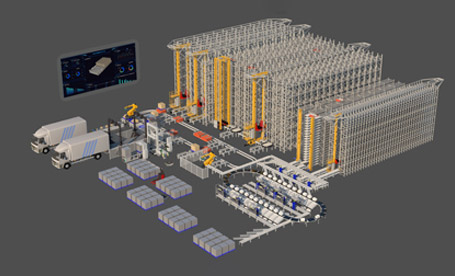
Rather than dedicating the ground floor mainly to storage, the new layout uses the first level as a flexible operating area for production transfer, warehouse interfaces, picking, buffering and outbound movement.
Upper levels are used for dense pallet storage.
This separates two activities with very different requirements:
upper levels — inventory that needs storage density
ground level — material that needs movement flexibility
The project uses 14 Pallet Latent AMRs for the main ground-floor material flow.
In the upper storage area, 7 Pallet Four-Way Shuttle Robots handle dense pallet storage, while 4 Lifters provide vertical transfer. The project also includes 2 Fork AMRs for another rack-handling area.
For an existing plant, this approach does more than add racks.
It uses vertical space for storage while keeping valuable ground-floor space available for dynamic logistics operations.
An existing-building project gives system designers less freedom than a new warehouse.
The building height is already fixed.
Every additional millimeter occupied by equipment reduces the height available for loads and rack levels.
DELIECN therefore applied its 125 mm ultra-thin Pallet Four-Way Shuttle Robot in the project.
The lower shuttle height helps preserve more usable vertical space within the existing building envelope.
The project also handles large pallet formats.
To provide better support for those loads, the shuttle lifting structure was customized according to the project requirements rather than applying the standard configuration unchanged.
For customers planning a warehouse retrofit, this is an important point.
The question is not simply whether the equipment fits inside the building.
The shuttle, rack, pallet format and available clear height have to work together if the project is expected to recover more storage capacity from an existing space.
The ground floor performs a different job from the upper storage area.
It needs to respond to changing material destinations.
The 14 Pallet Latent AMRs support production-line pickup, warehouse-interface transfer, temporary buffering, picking transfer, outbound staging and pallet return.
This is where mobile transport becomes useful.
A conveyor works well when origin and destination remain fixed.
In a paper packaging factory, however, one pallet may need storage, another may need temporary buffering, while a third is already required for shipment.
AMRs allow those destinations to change according to the task without installing a fixed conveyor route for every possible movement.
The project still uses fixed transfer equipment where the route is stable.
Mobile and fixed transport therefore perform different roles within the same logistics flow.
Storage capacity only creates value if finished goods can also leave the warehouse at the pace required by customer orders.
Paper packaging plants can face concentrated shipping periods in which many pallets need to be retrieved, staged and transferred toward loading areas within a short window.
Retrieving pallets faster does not automatically solve that problem.
If the dock cannot receive them at the same pace, the queue simply moves from the warehouse to the outbound area.
The project therefore includes dedicated outbound interfaces and buffer areas.
Finished goods can be staged according to outbound tasks before final loading.
This gives warehouse retrieval and loading operations some separation instead of forcing both processes to operate at exactly the same rhythm.
Finished-goods delivery is only one direction of the flow.
After goods leave, empty pallets still need to be collected and returned to storage or production areas that require replenishment.
If this process remains manual, part of the original handling problem simply comes back in another form.
The project therefore includes empty-pallet return as part of the planned logistics process.
Empty pallets can be consolidated before AMRs return them toward storage or production replenishment points.
The flow becomes:
production → storage → picking/outbound → empty-pallet return → production
For a packaging factory with frequent pallet circulation, this reverse flow is part of normal daily logistics rather than an auxiliary task.
Once several types of equipment operate together, coordination becomes as important as movement.
The project uses WMS, WCS and API interfaces to manage warehouse tasks and equipment execution.
WMS manages inventory, locations and warehouse tasks.
WCS coordinates equipment including Pallet Four-Way Shuttle Robots, AMRs, Lifters and conveying equipment according to current tasks and equipment status.
The API layer supports integration with the plant’s ERP and MES systems.
This allows production and business requirements to be translated into warehouse tasks and then into equipment execution.
The project is therefore not made up of several independent automated zones.
Production, storage and outbound operations can follow the same logistics task logic.
The project also uses a digital twin system connected with WMS/WCS.
Its role goes beyond displaying a 3D warehouse model.
Equipment status, operating tasks, material information and abnormal conditions can be presented through the visualization system.
For plant managers, this provides a clearer view of what is happening across several connected automation areas.
Instead of only discovering a problem after an outbound delay appears, operators can identify which task and equipment are involved and respond earlier.
For a multi-zone factory logistics project, that process visibility is particularly useful.
The project was not built around one headline piece of equipment.
Its value comes from changing how factory space and material flow are used together.
According to final project reporting, the upgraded warehouse provides approximately 2,700 effective pallet locations, while space utilization reached around twice the previous level.
Labor productivity was reported to have increased by approximately 200%.
The logistics system supports approximately 1,000+ pallets per day, while the 14 Pallet Latent AMRs can complete more than 1,000 pallet transfer cycles per day during peak operation.
Reported operating accuracy reaches 99.9%.
These results come from several decisions working together:
dense storage moves upward instead of occupying more ground-floor space;
AMRs connect changing material destinations instead of relying only on repeated manual transfer;
outbound buffering helps prevent shipping peaks from blocking warehouse retrieval;
empty-pallet return is included in the normal logistics process;
WMS/WCS coordinates different equipment around the same warehouse tasks.
The most useful part of this project is not the number of shuttle robots or AMRs.
It is the planning logic.
If an existing factory has limited ground-floor space, moving storage upward can release more useful area for production and logistics.
If production materials need to move between several changing destinations, mobile transport may be more practical than extending fixed conveyors everywhere.
If shipments are concentrated at certain times, outbound buffering should be planned together with warehouse throughput.
And if empty pallets continuously return to production, that reverse flow should be designed from the beginning.
For paper packaging manufacturers, warehouse modernization is therefore not simply about installing more equipment.
It is about reorganizing storage space, production logistics and outbound flow so they work together more effectively.