
Solutions and Consulting: With decades of experience, DELIECN provides intelligent warehousing & logistics solutions and consulting services for clients across a wide range of industries.
Learn More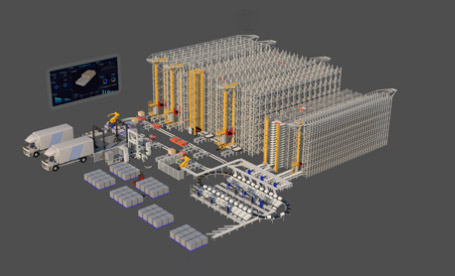
Solutions and Consulting: With decades of experience, DELIECN provides intelligent warehousing & logistics solutions and consulting services for clients across a wide range of industries.
Learn More
Solutions and Consulting: With decades of experience, DELIECN provides intelligent warehousing & logistics solutions and consulting services for clients across a wide range of industries.
Learn More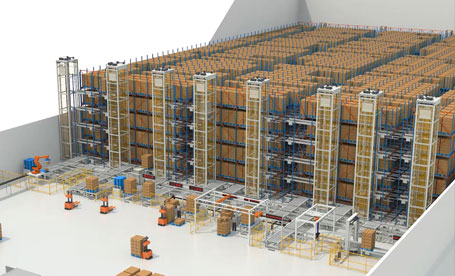
Solutions and consulting: DELIECN has decades of experience providing logistics & warehouse automation for the key industries.
Learn More
A warehouse with nearly 10,000 component types has a different problem from one holding a small number of high-volume products.
The challenge is not simply finding enough storage locations.
Production still needs the right component at the right time. Materials also need to move between storage, picking and multiple production areas without creating unnecessary manual travel or losing track of inventory.
This was the situation for a precision manufacturer producing electrical connectors, connector assemblies and electromechanical products for applications including rail transit, communications, industrial equipment, wind power and electric vehicles.
As the product range expanded, the new factory needed to manage more than 9,700 automotive component types while supporting frequent material movement and future production requirements.
The solution was not to force all materials into one storage architecture.
Instead, the warehouse was designed around two different material characteristics:
Pallet Stacker Crane AS/RS for palletized materials, and Tote Four-Way Shuttle AS/RS for smaller components.
Together, the two systems provide more than 18,700 storage locations.
That distinction is the key to understanding the project.
Palletized materials and small components create different warehouse problems.
Pallet loads require heavy-load handling and relatively large storage units.
Smaller components require much greater location density because thousands of different items may need to be available for production.
Using exactly the same storage architecture for both would force one material type to compromise for the needs of another.
The project therefore separates the two material flows.
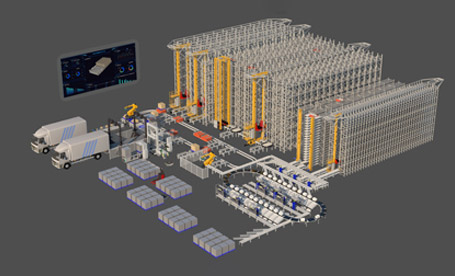
The pallet side uses a 14-level Pallet Stacker Crane AS/RS, served by 2 Pallet Stacker Cranes.
The small-parts side uses a 22.3 m-high, 51-level Tote Four-Way Shuttle AS/RS, with 8 Tote Four-Way Shuttle Robots working in coordination.
The wider system also includes 4 RGVs, level-changing lifters, high-speed Tote Lifters, conveyors and warehouse software.
Each technology has a specific role, while the complete system operates as one manufacturing logistics network.
The small-parts warehouse is where the storage challenge becomes most obvious.
With more than 9,700 component types to manage, continuing with conventional floor storage would quickly consume valuable factory space.
The Tote Four-Way Shuttle AS/RS instead makes extensive use of vertical space.
The tote storage structure reaches 22.3 m in height and 51 storage levels.
The objective was not simply to place more totes into a taller rack.
The storage structure had to increase the number of available locations without allowing storage and picking activities to spread across a larger floor area.
The completed project provides more than 18,700 storage locations across the pallet and tote systems.
Project data reports space utilization at approximately 10 times the previous floor-storage level.
For a manufacturer whose product range continues to expand, this changes the relationship between SKU growth and floor-space requirements.
More component types do not automatically have to mean a larger storage footprint.
The tote warehouse uses 8 Tote Four-Way Shuttle Robots to support storage and retrieval across the multi-level rack structure.
The robots can move within the main and cross directions of the rack system and work with the level-changing lifters to access different storage levels.
The project’s calculated tote-handling capability is approximately 323 totes/hour.
This is a system-level figure, not the speed of one shuttle robot.
The actual handling capability depends on the coordinated operation of the shuttle robots, lifters, conveyors and control system.
That distinction matters when evaluating an automated warehouse.
A robot may have a high individual travel speed, but the useful throughput of the warehouse depends on the complete route from storage to the point where the material is needed.
The project covers logistics across Floors 1 to 4, so the warehouse could not be designed as an isolated storage area.
Materials need to move between production, storage and picking according to manufacturing requirements.
On the pallet side, Pallet Stacker Cranes handle automated storage and retrieval, while RGVs transfer pallet loads at the warehouse interface.
On the tote side, level-changing lifters and high-speed Tote Lifters move containers between storage levels and operating areas, with conveyors connecting the relevant process points.
This changes the working pattern for operators.
Instead of repeatedly entering dense storage areas to locate components, required totes can be retrieved automatically and presented to the picking process.
The warehouse therefore supports a goods-to-person approach for small-component picking.
For a manufacturer handling thousands of component types, removing unnecessary walking from the process can have a meaningful effect on daily workload.
The warehouse had to cope with more than a large inventory.
The daily inbound peak was 370 SKUs, while the daily outbound peak reached 872 SKUs.
These figures describe the peak SKU workload and task complexity.
They should not be confused with the tote system’s approximately 323 totes/hour handling capability.
The two sets of figures describe different things.
One describes the daily SKU workload.
The other describes the calculated system-level tote-handling capability.
That distinction is important in a warehouse serving a large number of component types.
One production order may require several different components. Another order may require the same component at a different time.
The warehouse therefore needs to identify the correct material, retrieve it, deliver it to the correct process and keep the inventory status updated.
The combination of dense storage, automated retrieval and goods-to-person picking addresses that process rather than only the storage problem.
Physical equipment is only one part of the solution.
With thousands of component types and multiple production areas, the warehouse also needs a system that knows what should move, where it should go and when the task should be executed.
The project uses WMS/WCS, together with API interfaces and a 3D Visualization Central Control System.
WMS manages inventory, storage locations and warehouse tasks.
WCS coordinates the execution of those tasks across the Pallet Stacker Cranes, Tote Four-Way Shuttle Robots, RGVs, lifters and conveyors.
The system also connects with the customer’s existing ERP and MES environment through system interfaces.
The 3D visualization system provides a centralized view of warehouse, production logistics and equipment status.
For a factory with thousands of component types, this digital connection is closely tied to the physical operation.
The warehouse needs to remain synchronized with production requirements while equipment is executing the corresponding material movements.
The completed solution includes:
• More than 18,700 storage locations
• More than 9,700 automotive component types
• A 14-level Pallet Stacker Crane AS/RS
• 2 Pallet Stacker Cranes
• A 22.3 m-high, 51-level Tote Four-Way Shuttle AS/RS
• 8 Tote Four-Way Shuttle Robots
• 4 RGVs
• Level-changing lifters and high-speed Tote Lifters
• Goods-to-person picking
• WMS/WCS, API and 3D Visualization Central Control System
• Production logistics coverage across Floors 1 to 4
Project data reports approximately 10 times the previous floor-storage level in space utilization and an approximately 200% improvement in warehouse turnover efficiency.
The value does not come from one machine.
The pallet side handles one type of material requirement.
The tote side addresses another.
RGVs and lifters connect different operating levels, while conveyors provide the physical links between processes.
WMS/WCS keeps inventory information and equipment execution connected.
That is what makes the project relevant to precision manufacturers with thousands of component types.
The objective was not simply to build a taller warehouse.
It was to store more materials in the available space, retrieve the right components when required, reduce unnecessary operator travel and keep production logistics connected to inventory information.