
Solutions and Consulting: With decades of experience, DELIECN provides intelligent warehousing & logistics solutions and consulting services for clients across a wide range of industries.
Learn More
Solutions and Consulting: With decades of experience, DELIECN provides intelligent warehousing & logistics solutions and consulting services for clients across a wide range of industries.
Learn More
Solutions and Consulting: With decades of experience, DELIECN provides intelligent warehousing & logistics solutions and consulting services for clients across a wide range of industries.
Learn More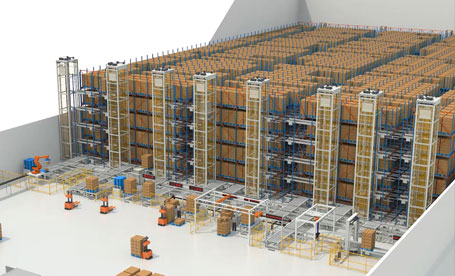
Solutions and consulting: DELIECN has decades of experience providing logistics & warehouse automation for the key industries.
Learn More
For battery aluminum foil, metal coils, heavy components, and other manufacturing materials, traditional forklift handling and floor stacking often struggle to meet storage density, load safety, and stable inbound/outbound requirements at the same time.
In one battery aluminum foil project, the customer had an annual production capacity of 150,000 tons of finished battery aluminum foil. The stored materials were mainly oversized, heavy, and carried by multiple types of load units. The maximum single load reached 2,500 kg.
As production capacity increased, the original storage mode could no longer meet the customer’s storage and material flow requirements. Materials were stored in different areas of the plant, including temporary storage zones near roads and shipping areas. Goods searching, forklift handling, stacking safety, and inventory traceability all became difficult to control.
To solve these problems, the customer applied DELIECN ultra-high heavy-duty pallet stacker cranes to realize automated storage and retrieval for different heavy-load materials.
The customer’s materials ranged from approximately 500 kg to 2,500 kg. When this type of material is handled mainly by forklifts, operation depends heavily on experienced drivers. Multi-layer floor stacking and limited working space also increase safety risks.
The original warehouse mainly used floor stacking. As production increased, some finished goods had to be stored in scattered plant areas. This affected site logistics, safety management, and overall warehouse efficiency.
The project included different iron frames and wooden boxes. This required the automated system to handle not only heavy loads, but also different carrier dimensions.
The customer’s daily outbound volume was approximately 450 tons, and shipments were mainly concentrated from 18:00 to 24:00. This required the system to maintain stable operation under high-bay, heavy-load, and continuous working conditions.
The project was configured with 8 DELIECN ultra-high heavy-duty pallet stacker cranes, including 1 single-deep stacker crane and 7 double-deep stacker cranes. The system also included conveyor lines, WMS, WCS, front-end inbound/outbound stations, and related inspection and safety devices.
By connecting stacker cranes with front-end conveyor equipment, the system enabled automated heavy-load storage and retrieval, while also improving material flow between production, storage, and shipping.
The project used a 31.6 m high-bay racking system and transformed the storage mode from floor stacking to high-bay automated storage. The final design provided 13,790 pallet locations, increasing storage capacity by approximately 5 times compared with the original storage mode.
The system was designed for heavy load units up to 2,500 kg. For battery aluminum foil and similar materials, this means the warehouse can move away from high-risk forklift stacking and shift toward controlled automated storage and retrieval.
With 8 ultra-high heavy-duty pallet stacker cranes operating together, the system supports the customer’s daily inbound volume of approximately 450 tons and daily outbound volume of approximately 450 tons. This corresponds to about 1,300 load units per day.
This project verifies the continuous operation capability of DELIECN heavy-duty pallet stacker cranes in high-intensity manufacturing environments.
The project separated production inbound flow and shipping outbound flow. The side closer to production was used for inbound, while the side closer to shipping was used for outbound. This reduced route crossing and improved plant logistics efficiency.
The inbound and outbound stations were also equipped with visual guidance for forklift operators. When a task is assigned to a station, the operator can view task information on the screen and respond accordingly. This reduces manual communication errors and improves human-machine coordination.
The project uses WMS, WCS, and digital twin visualization to support inbound/outbound task management, inventory status, storage location visibility, stocktaking, task tracking, and abnormal alarm management.
After implementation, the project helped the customer achieve:
This project shows that ultra-high heavy-duty pallet stacker cranes are not only suitable for general pallet storage. They can also support battery aluminum foil, metal coils, heavy components, automotive parts, machinery parts, and other high-bay heavy-load storage scenarios.
For customers with large, heavy, and multi-specification materials, the key is not only the stacker crane itself. The final solution must integrate stacker crane selection, racking design, carrier compatibility, inbound inspection, visual guidance, WMS/WCS, and safety protection into one complete project.
Need automated storage for heavy battery materials, aluminum foil, metal coils, or oversized load units?
Talk to DELIECN about ultra-high heavy-duty pallet stacker crane ASRS solutions.