
Solutions and Consulting: With decades of experience, DELIECN provides intelligent warehousing & logistics solutions and consulting services for clients across a wide range of industries.
Learn More
Solutions and Consulting: With decades of experience, DELIECN provides intelligent warehousing & logistics solutions and consulting services for clients across a wide range of industries.
Learn More
Solutions and Consulting: With decades of experience, DELIECN provides intelligent warehousing & logistics solutions and consulting services for clients across a wide range of industries.
Learn More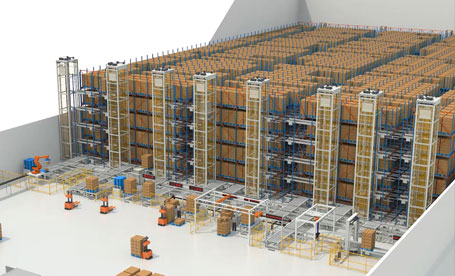
Solutions and consulting: DELIECN has decades of experience providing logistics & warehouse automation for the key industries.
Learn More
In mechanical manufacturing, the biggest barrier to flexibility is no longer production capability—it is the gap between production planning and material execution speed.
Even highly automated factories often struggle with:
• Slow response to engineering changes
• Disconnected warehouse and production systems
• High dependence on manual coordination
• Inventory inaccuracy across multi-SKU environments
In this context, warehousing is no longer a support function—it becomes the decisive layer that determines whether manufacturing can truly be flexible.
DELIECN addresses this challenge by providing a fully integrated automation architecture, transforming warehouses into a real-time execution system for production.
Traditional warehouses mainly serve one purpose: storing inventory.
DELIECN redefines this role into three layers:
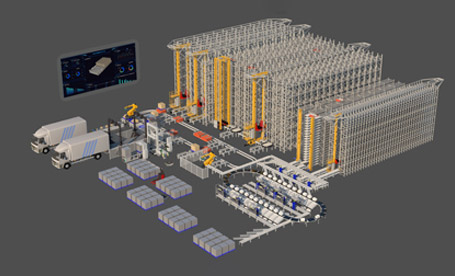
• Storage Layer →high-density AS/RS structure
• Execution Layer →stacker cranes and conveyor automation
• Decision Layer →WMS + WCS intelligent control
This structure allows the warehouse to evolve from a passive storage zone into an active manufacturing coordination system.
Flexibility in manufacturing depends on how quickly materials can move—not just how they are stored.
DELIECN automation hardware creates this foundation:
Instead of expanding factory space, AS/RS compresses storage vertically and structurally, enabling:
• High-density SKU consolidation
• Fast vertical retrieval cycles
• Stable storage for mixed mechanical parts
Stacker cranes act as the “movement engine” of the system:
• Automated retrieval and placement
• Continuous multi-aisle operation
• Precise synchronization with system tasks
Conveyors eliminate manual handling between processes:
• Direct line-to-line material delivery
• Buffering between production stages
• Continuous flow without interruption
Together, these components replace fragmented logistics with a continuous material flow system.
Hardware alone cannot achieve flexibility. The key transformation comes from system intelligence.
The warehouse management system organizes chaotic multi-SKU environments into:
• Real-time inventory mapping
• Dynamic picking strategies
• Multi-order prioritization logic
The control system ensures execution accuracy:
• Schedules every movement in real time
• Coordinates equipment across the system
• Handles exceptions automatically
Instead of operators managing forklifts and instructions manually, the system becomes self-orchestrating.
With DELIECN integrated systems, production no longer waits for materials.
Instead:
• Production orders automatically trigger warehouse actions
• Inventory updates reflect real-time consumption
• Material flow adjusts dynamically to production priorities
This creates a shift from:
“Warehouse responding to production”to
“Production and warehouse operating as one system”
The value of DELIECN approach is not only operational—it is structural.
Manufacturers achieve:
• Faster response to design and product changes
• Reduced dependency on manual scheduling
• Higher resilience in multi-product environments
• More stable production planning accuracy
• Scalable warehouse expansion without rebuilding factories
Most importantly, it enables factories to move toward continuous flexible production instead of batch-limited operations.
With full-stack integration of hardware and software, DELIECN enables a shift in how factories are built and operated.
Warehousing is no longer an auxiliary system.
It becomes:
• A production synchronization center
• A real-time logistics execution engine
• A data-driven decision node for manufacturing
The future of mechanical manufacturing is not defined solely by faster machines, but by how effectively materials, data, and production systems are synchronized.
By transforming warehousing into an intelligent execution infrastructure, DELIECN enables manufacturers to bridge the long-standing gap between planning and reality—unlocking true flexibility, scalability, and operational continuity in modern production environments.