
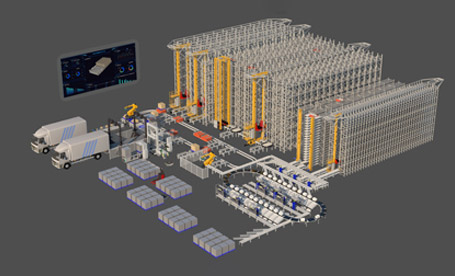
Solutions and Consulting: With decades of experience, DELIECN provides intelligent warehousing & logistics solutions and consulting services for clients across a wide range of industries.
Learn More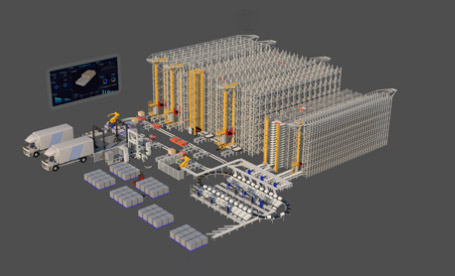
Solutions and Consulting: With decades of experience, DELIECN provides intelligent warehousing & logistics solutions and consulting services for clients across a wide range of industries.
Learn More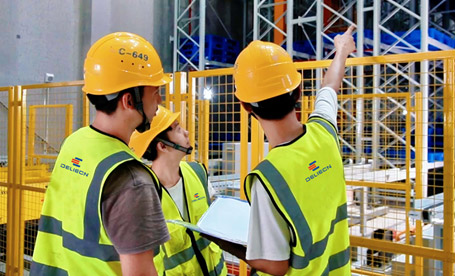
Solutions and Consulting: With decades of experience, DELIECN provides intelligent warehousing & logistics solutions and consulting services for clients across a wide range of industries.
Learn More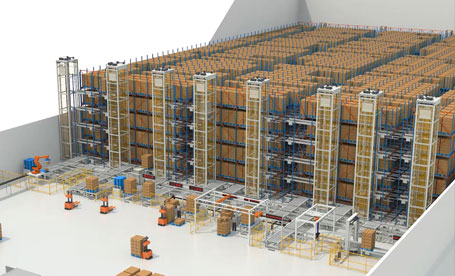
Solutions and consulting: DELIECN has decades of experience providing logistics & warehouse automation for the key industries.
Learn More
As a core hub in Toyota’s East China service supply chain, the Changshu spare parts warehouse supports parts supply for hundreds of dealers.
As vehicle ownership continues to grow, spare parts need to be found, picked, and delivered faster. This directly affects dealer service response and customer satisfaction.
However, the warehouse faced a large SKU volume and highly complex material types. Toyota needed a smarter warehouse upgrade to shorten the overall supply cycle. Based on this need, Toyota worked with DELIECN to upgrade its spare parts warehouse.
Results:
✓ Refined zone-based management for nearly 45,000 automotive spare parts SKUs
✓ Supply cycle shortened from 8 days to 2 days
✓ Full-process traceability across storage, picking, handling, and outbound operations, with 99.9% accuracy
Many SKUs were mixed in storage. Orders were scattered, and manual searching was slow.
Material sizes varied greatly. Different spare parts had different storage requirements and turnover rhythms.
Small and large parts were often included in the same order. Cross-zone handling was difficult and could slow down fulfillment.
Multiple zones, devices, and order types operated at the same time. The customer needed more refined warehouse operation management.
The Toyota warehouse stores H1200 mm and H1675 mm storage cages. It also handles long parts, irregular parts, and low-frequency spare parts in sizes such as 1100 × 1130 × 1165 / 1675 mm and 1400 × 2200 × 1675 mm. These materials have different storage requirements and turnover frequencies.
For storage cage materials that require dense storage and high-throughput access, Toyota deployed DELIECN 125 mm ultra-thin pallet four-way shuttle robots. This design helps release more vertical storage space.
Fourteen pallet four-way shuttle robots work with level-changing lifters to support multi-level storage and retrieval. Together, they achieve 90 lines/hour for large spare parts of different specifications.
For long and large parts that still require flexible forklift operation, Toyota uses narrow-aisle racking. This helps concentrate forklift travel paths and improve high-bay space utilization.
For irregular parts, low-frequency parts, or spare parts that are not suitable for automated dense storage, mezzanine racking is used for layered storage.
This multi-zone planning allows different types of large spare parts to be stored in more suitable ways, instead of forcing all materials into one storage model.
The pressure in the small-parts area comes from many SKUs, fragmented orders, and high picking frequency.
In manual picking, workers need to search, check, and pick items across thousands of storage locations. One worker may walk up to 30,000 steps per day. A large amount of time is spent on searching paths. As the number of SKUs grows, labor intensity also increases. The risks of wrong picking and missed picking also rise.
Therefore, Toyota chose DELIECN Mini-FlyBox to support high-SKU small-parts storage and goods-to-person picking.
The system provides more than 17,000 tote locations, including H300 and H450 tote storage areas for different small-parts storage needs.
In this project, 18 Mini-FlyBox units operate in 1100 mm narrow aisles and work together with 54 Tote AMRs. The total inbound and outbound throughput reaches 870 lines/hour.
This makes multi-SKU and fragmented order processing more efficient and accurate. Operators no longer need to spend most of their time walking and searching. Instead, the system brings the required totes to the picking side, improving picking response and reducing manual workload.
Automotive spare parts orders may include small parts, large parts, irregular parts, and other spare parts at the same time. These items need to be picked and gathered from different zones.
If each zone relies mainly on manual transfer, waiting, missed shipments, wrong shipments, or repeated handling may occur during peak hours. This can affect order fulfillment.
The goal of cross-zone handling is to help different materials in the same order move smoothly to later sorting and outbound nodes.
Toyota deployed 54 Tote AMRs and 24 AGVs to connect different warehouse zones.
Tote AMRs handle tote-based transfer, small-parts order flow, and flexible transport tasks. AGVs support heavier loads and cross-zone material movement. With clearer equipment roles, the warehouse reduces manual cross-zone handling and waiting time. Material flow between zones also becomes more continuous and stable.
In this project, DELIECN WMS is integrated with Toyota’s TOPSS sales system and upstream WMS. Business requirements are converted into executable warehouse tasks.
The WMS manages inventory, storage locations, inbound and outbound processes, and order tasks. It also uses data such as inbound and outbound frequency, inventory turnover, and task changes to support resource planning, zone optimization, and operation improvement.
The WCS dispatches field equipment, including pallet four-way shuttle robots, Mini-FlyBox units, Tote AMRs, AGVs, and conveyors. Based on task priority, equipment status, and path conditions, it coordinates equipment execution and supports equipment status monitoring and abnormal alerts.
The 3D Visualized Central Control System can simulate and recreate the warehouse operation scene. Through the LED large screen, it visualizes data from the WMS, WCS, and field equipment systems.
Toyota managers can view zone layout, material flow, task progress, inventory status, equipment operation, and abnormal alerts on one screen. This helps them make more informed decisions and manage complex warehouse operations with better visibility.
From the upgrade of near-line production packaging and integrated packaging-storage operations to the full operation of the smart warehouse, DELIECN’s multi-zone automation solution has helped us shorten the supply chain process by 80%. The supply cycle has also been reduced from 8 days to 2 days. This is very important for improving spare parts response, supporting dealer delivery, and keeping the supply chain stable.
— Mr. Ge, Customer Representative
Toyota’s spare parts warehouse upgrade provides a practical reference for multi-SKU, mixed-storage automotive parts operations.
Facing similar operational bottlenecks? Reach out to the DELIECN team to explore tailored automation solutions designed for your specific facility.